The Power of Patterns: Building Early Math Skills Through Play
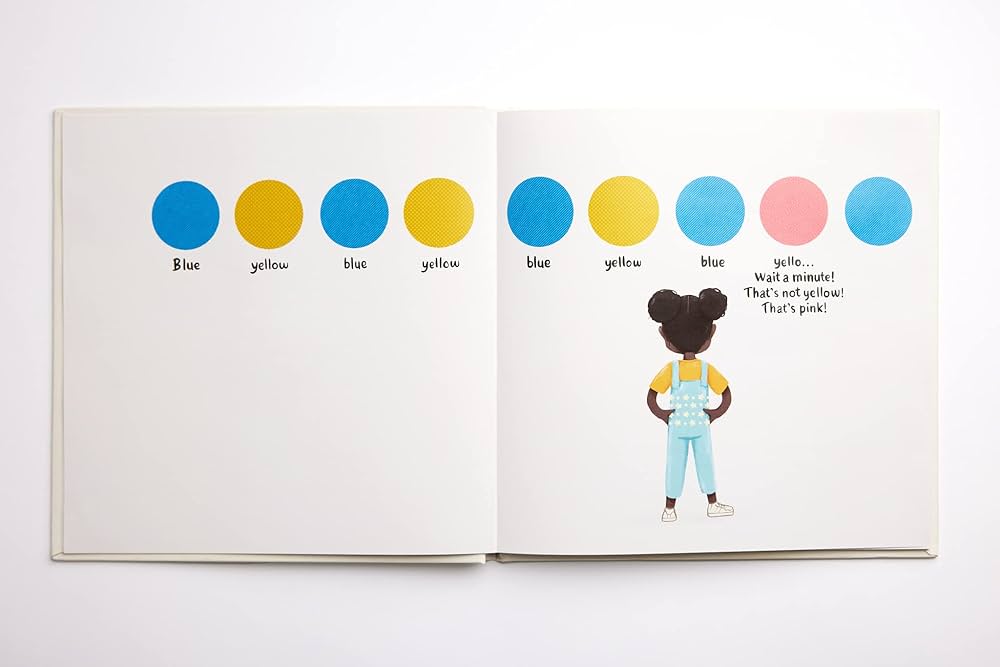
“Blue, yellow, blue, yellow, blue, yellow, blue…hey that’s not yellow! That’s pink”
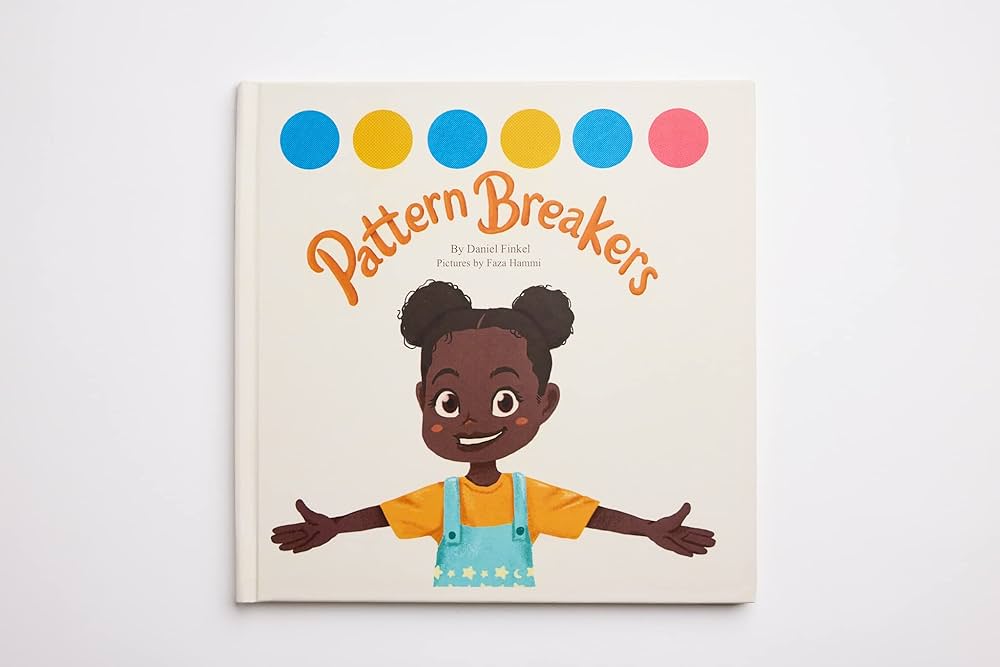
I peek in the corner to see four year old, Marlow, “reading” his favorite new book, Pattern Breakers by Daniel Finkel and Fazza Hammi. This playful book has opened up a whole new world of recognizing and finding patterns in our classroom. This book is one of those instant classics that seems so simple, you are sure the children will get bored with quickly. No, just the opposite! (Haha, that’s math!) Children love to read this book over and over and that playful book has led to lots of pattern play in the classroom, along with pattern recognition in our daily lives.
Patterns are everywhere and they play a crucial role in early math education . They form the foundation for learning not just math but critical thinking, problem-solving, and memory skills. Recognizing and reinforcing patterns in everyday life can significantly boost a child’s math education journey. Understanding and identifying patterns is one of the most fundamental skills a child can learn, and it’s an essential step in building a strong mathematical foundation.
In the classroom, pattern recognition serves as an introduction to key mathematical concepts such as algebra and number sequences. When children engage with patterns, they are not only recognizing repetition — they are learning to predict, reason, and understand relationships, which are all foundational skills for more complex math later on. Pattern awareness is actually an early form of algebraic thinking. Understanding patterns early sets the stage for success in later math learning.
Children are engaging in pattern-based activities without even knowing it. Think about the act of crawling or walking. Left-right, left-right, left-right — that’s a repeating pattern! Simple actions like these help build a child’s awareness of repetition and rhythm.
When children engage with patterns, they are practicing important mathematical skills such as:
- Sequencing: Understanding the order of events or steps.
- Prediction: Predicting what comes next in a pattern.
- Classification: Sorting objects based on shared attributes (color, shape, size).
- Counting: Recognizing number patterns, like “1, 2, 1, 2” or “1, 2, 3, 1, 2, 3.
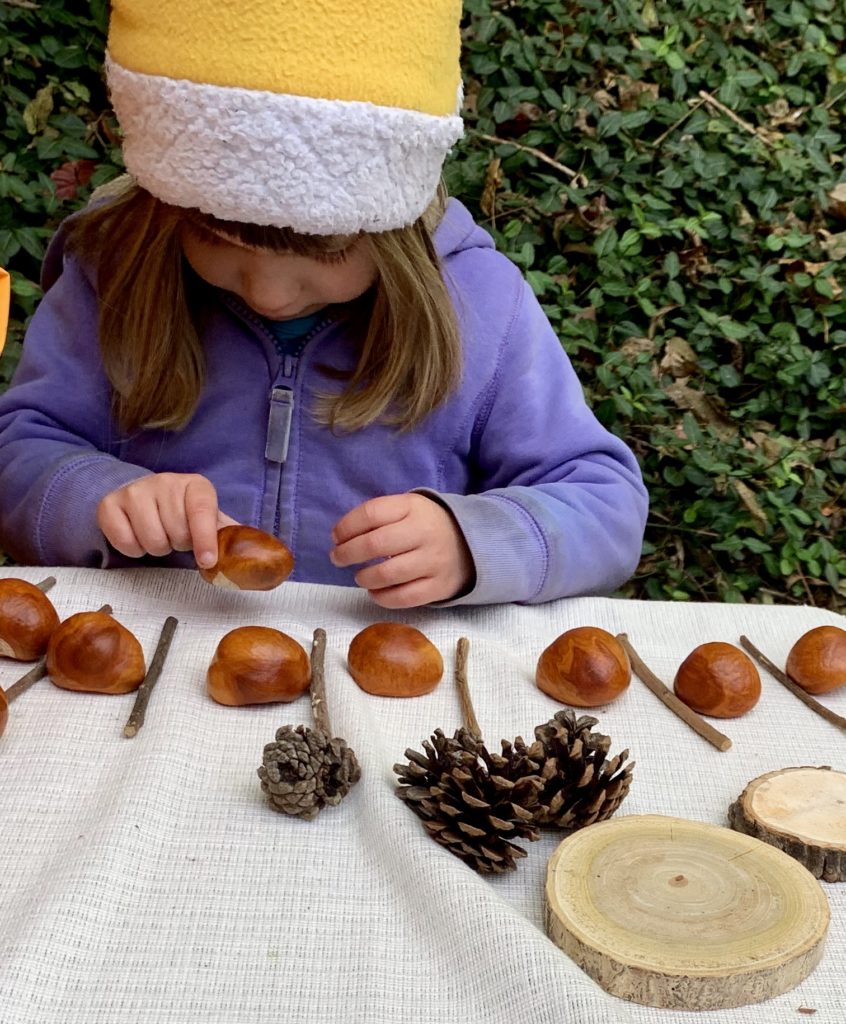
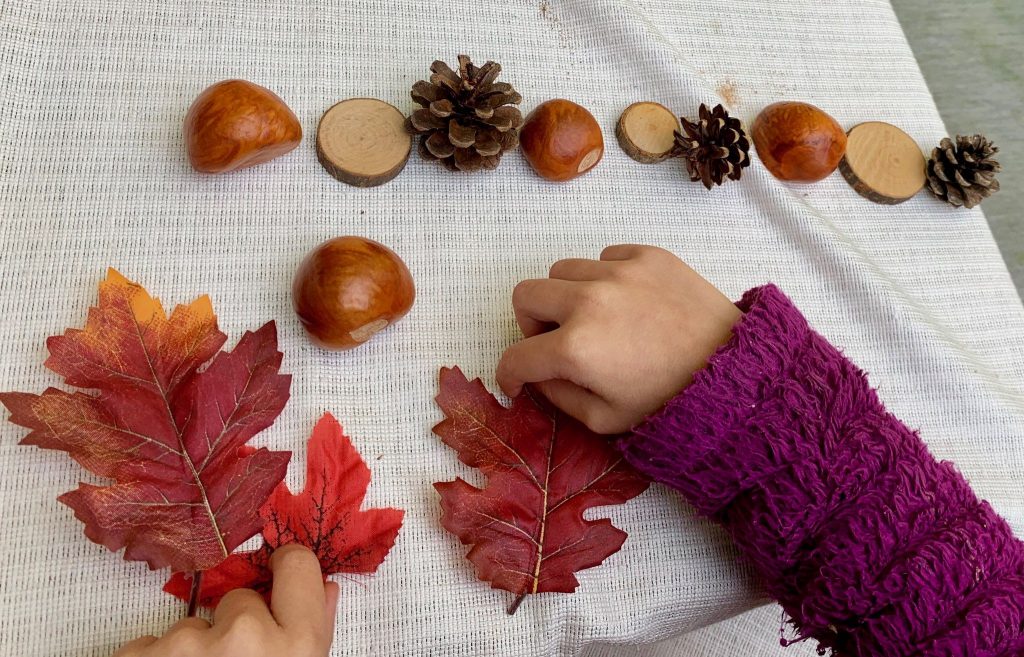
One of the best ways to reinforce pattern recognition is through natural exploration. Children can find patterns everywhere — in nature, in everyday routines, and with objects they interact with. Take a walk outside and let your child observe the patterns in the leaves, flowers, or even the acorns and pinecones that fall from trees.
Adding natural loose parts, like leaves, pebbles, or pinecones, into the classroom offers endless possibilities for pattern play. Children can create patterns based on size, color, shape, or texture. This hands-on approach not only reinforces pattern recognition but also encourages fine motor skills and creativity.
Patterns don’t just live in math centers or storybooks—they’re woven into the fabric of children’s play. When a child lines up blocks by color, claps out a rhythm, or builds towers with alternating shapes, they’re engaging in pattern-based thinking. These moments of play are rich with mathematical meaning. They help children internalize the idea that things can repeat, change predictably, and be organized in meaningful ways. This is the essence of algebra: understanding structure, relationships, and rules.
As educators, we can nurture this early algebraic thinking by naming patterns, asking questions like “What comes next?” or “What do you notice?” and encouraging children to create their own patterns. When children invent patterns, they’re not just copying—they’re constructing logic. They’re building the mental muscles that will later help them solve equations, understand functions, and decode number systems.
Even simple pattern games—like alternating claps and stomps, or arranging snack items in a repeating sequence—can spark deep mathematical conversations. These activities build fluency in recognizing regularity and change, which are key components of algebraic reasoning.
The beauty of pattern play is that it’s accessible to all learners. It’s visual, tactile, rhythmic, and joyful. And most importantly, it lays the groundwork for future mathematical discoveries.
Daniel Finkel, the author of this book, is a leading advocate for creative math education. Finkel is the co-founder of Math4Love, a website dedicated to making math more accessible, engaging, and fun for both teachers and students. His approach focuses on the power of play in learning, encouraging students to explore math in a hands-on, inquiry-based way.
By embracing the power of patterns in classroom play, educators can help children develop a lifelong love of learning and a deep understanding of the math concepts that will guide them throughout their education. With the guidance of resources like Pattern Breakers! and the insights from Math4Love, teachers can create an engaging, playful math environment that fosters a love for patterns and problem-solving from the very beginning.
The early math class is very important for children at a very young age. Through this class the children can learn as follows :
– recognizing shapes such as identify basic shapes (circle, square, triangle, rectangle), name shapes in their environment, notice similarities and differences between shapes
– understanding shape attributes as how many sides a shape has, how many corners
– building spatial awareness as position of words such as in, on, under, above, next, between and movement words as around, over, under and directions as left, right, forward, backward
– combining and separating shapes
– transforming shapes as turn, rotate, slide
That is why the early math is important on a very young age, teaches them to be aware of what surrounds them and to make difference between shapes and movements.
Thank you for highlighting the role of patterns in early math! I appreciate the concrete examples of how pattern play builds foundation for algebraic thinking and helps children make predictions, classify and count. I love the idea of using natural materials like leaves and pebbles to extend pattern recognition beyond the classroom. These strategies inspire me to incorporate more pattern exploration in my lessons.
Thank you for your kind words, Robert! It seems many of us really enjoyed math until we hit Algebra. I often wonder if someone would have shared that we were dealing with patterns, or let us play with manipulative to “see” the pattern, if that wouldn’t have helped us understand the concepts. I love telling kids they are doing algebra. I hope that new vocabulary word sticks with them as a time of playful fun! Wouldn’t that be nice?
I believe an early understanding of patterns and a development of number sense are the keys to preparing children for the more complex math topics which they will encounter. Also life is all about patterns, so it should be a natural topic to explore!
Children have to see math in everything of course. I agree with you on how important patterns are.
Love relating patterns to real life!
Perfect to learn pattern recognition and sequencing.
I like the concept of taking nature and making patterns!
Learning through play is awesome
I will be ordering this book and introducing it and patterns to my kids soon